Why Montessori?

Understanding the scientific foundation of the world's most successful early childhood system.

Scientific Education

The Absorbent Mind & Child Autonomy

Developed by Dr. Maria Montessori, Italy's first female physician, the Montessori system is built upon clinical observations of how children naturally learn. Dr. Montessori realized that between birth and age six, children possess an "absorbent mind," allowing them to absorb language, order, and spatial dynamics effortlessly from their surroundings.

In a Montessori environment, children are not passive listeners; they are active investigators. Rather than sitting at desks listening to a teacher lecture at a blackboard, children choose activities from shelves containing scientific materials, working at their own pace individually or in small clusters.
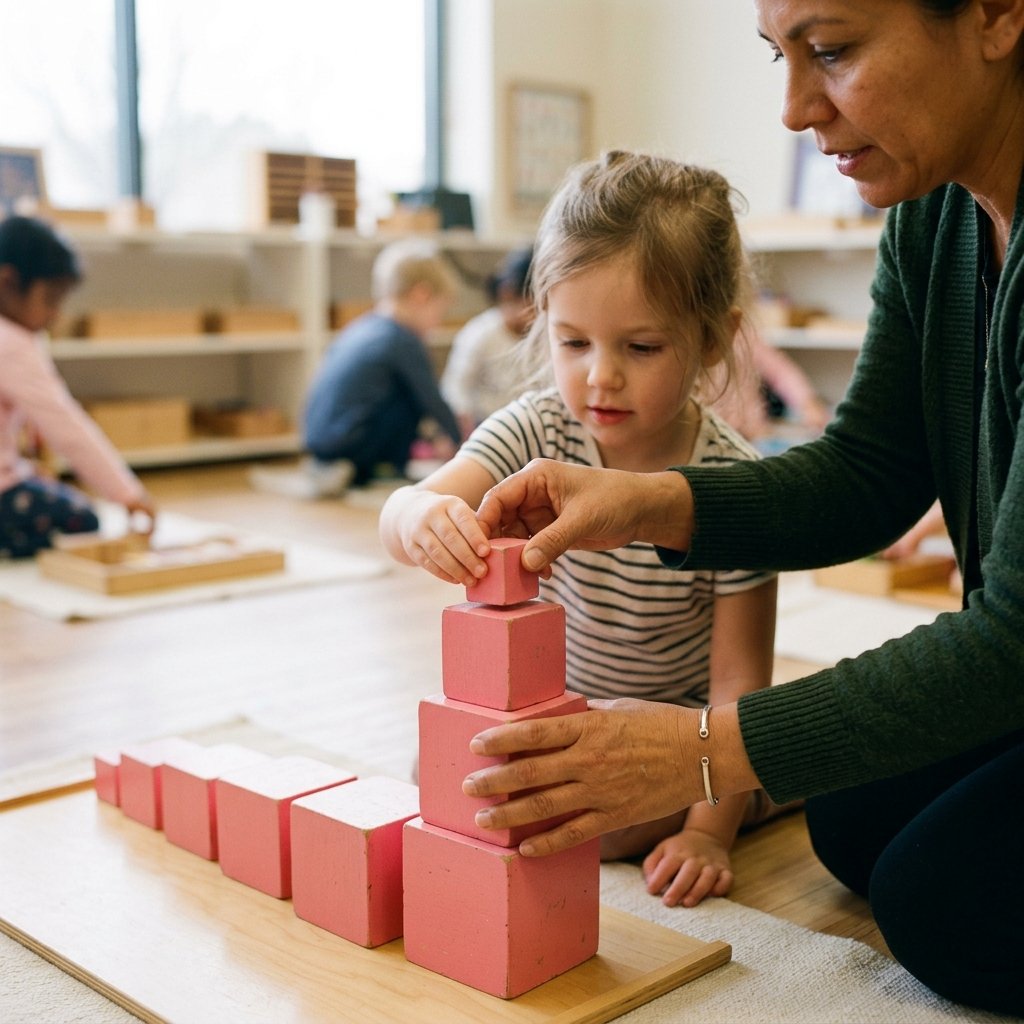
Children working with Montessori Cylinders
The Core Contrast

Traditional Pre-school vs. Montessori

Feature Traditional Nursery School Montessori Environment
Role of Teacher Center of attention, directs all lessons ("sage on stage") Observer, facilitator, guides child choice ("guide on side")
Learning Pace Same pace for all children, fixed schedules Individualized pace, child chooses when to repeat
Instruction Tools Worksheets, text-books, blackboard diagrams Hands-on, self-correcting wooden scientific apparatus
Class Structure Same-age groups (e.g., all 3-year-olds) Mixed-age grouping (allows older to mentor younger)
Motivation External rewards, gold stars, grades, competition Internal satisfaction, joy of discovery, collaboration
Natural Windows of Opportunity

Understanding Sensitive Development Periods

Order & Routine

Ages 1.5 to 3 Years

During this period, children have a deep biological need for order. Standard layouts and classroom routines build internal security and reasoning capacities.

Language Development

Birth to 6 Years

An explosive window where phonetic vocabulary, sandpaper letters, and conversation naturally build writing and reading capabilities.

Sensory Refinement

Ages 2 to 6 Years

Through isolating textures, colors, pitches, and geometry, children categorize their environment and sharpen their cognitive senses.

Global Career Growth

The demand for certified Montessori educators has spiked globally. Modern parents seek nursery programs that avoid screens and rote desk-based learning, prioritizing cognitive coordination, focus, and social confidence.


50k+

Montessori pre-schools worldwide

High

Salary packages for certified experts

Professional Outlook

Why Certified Teachers Succeed

In Chennai and global school markets, generic nursery teacher course certificates are standard, but schools actively pay premium brackets to candidates holding authentic **Montessori certifications**.

Our diploma programs give you specific competency in running Montessori lab apparatus, drafting structured observation logs, designing albums, and organizing mixed-age environments. That is why graduates of Meet Montessori Institute achieve immediate placements in top-tier international kindergartens.

Start Your Qualification
Call Now Apply Now